
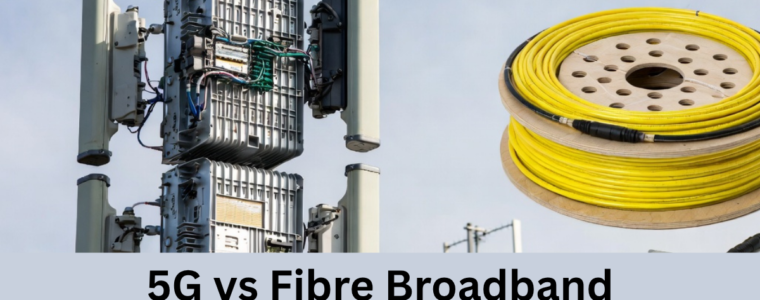
Reliable, high-speed internet is essential for modern businesses—but choosing the right connectivity option can be challenging. Two of the most talked-about solutions today are 5G business internet and fibre broadband.
So, how do they compare? And more importantly, which is better for your business in the UK?
In this guide, we break down 5G vs fibre UK performance, reliability, cost, and real-world use cases to help you make an informed decision.
What Is Fibre Broadband?
Fibre broadband uses fibre optic cables to transmit data as light signals, providing fast and stable internet connections.
There are two main types in the UK:
- FTTC (Fibre to the Cabinet) – fibre part-way, then copper to your premises
- FTTP (Fibre to the Premises) – full fibre, offering the best performance
Key Characteristics
- High and consistent speeds
- Low latency
- Strong reliability
- Fixed-line installation required
What Is 5G Business Internet?
5G broadband uses next-generation mobile networks to deliver high-speed internet wirelessly via a router or gateway.
Instead of a fixed cable, your connection comes from nearby mobile towers.
Key Characteristics
- Ultra-fast speeds (depending on coverage)
- Rapid deployment (plug-and-play)
- Wireless flexibility
- Performance varies by signal strength
5G vs Fibre UK: Key Differences
Here’s a side-by-side comparison of the two technologies:
| Feature | 5G Broadband | Fibre Broadband |
| Speed | Up to ~1 Gbps (variable) | Up to 1 Gbps+ (FTTP) |
| Latency | Low (10–30 ms) | Very low (5–15 ms) |
| Reliability | Good but signal-dependent | Extremely stable |
| Installation | Fast (days) | Slower (weeks) |
| Mobility | Portable | Fixed location |
| Availability | Expanding (urban-focused) | Growing but still limited in some areas |
| Cost | Competitive, scalable | Higher for dedicated lines |
Speed and Performance: Which Is Faster?
Fibre Broadband
Fibre—especially FTTP—offers:
- Guaranteed speeds (closer to advertised rates)
- Symmetrical upload and download (ideal for business use)
- Minimal performance fluctuation
5G Broadband
5G can deliver impressive speeds, but:
- Performance varies based on location, signal strength, and network congestion
- Upload speeds are often lower than fibre
- Speeds may fluctuate during peak times
Verdict: Fibre is more consistent, but 5G can rival it in strong coverage areas.
Reliability and Uptime
Fibre
Fibre broadband is widely considered the gold standard for reliability:
- Not affected by weather or interference
- Stable performance over time
- Ideal for mission-critical operations
5G
5G is improving rapidly but can be affected by:
- Signal obstructions (buildings, terrain)
- Network congestion
- Coverage gaps in some UK regions
Verdict: Fibre wins for consistent uptime, but 5G is strong when used as part of a resilient setup (e.g., bonded or failover).
Installation and Deployment Speed
Fibre
- Requires physical installation
- Lead times can range from 2 weeks to several months
- May involve infrastructure upgrades
5G
- Plug-and-play setup
- Can be deployed in days or even hours
- No need for cabling works
Verdict: 5G is far faster to deploy.
Flexibility and Scalability
5G Advantages
- Easily relocatable
- Ideal for temporary sites or growing businesses
- Can be scaled with additional data or devices
Fibre Limitations
- Fixed to a single location
- Scaling often requires infrastructure changes
Verdict: 5G offers far greater flexibility.
Real-World Business Use Cases
1. Offices in Urban Areas
Best option: Fibre (with 5G backup)
- Fibre provides consistent speeds for daily operations
- 5G can act as a failover or secondary connection
2. Rural or Underserved Locations
Best option: 5G or hybrid solution
- Fibre may not be available
- 5G provides a viable high-speed alternative
- Often used in combination with bonded routers
3. Construction Sites & Temporary Locations
Best option: 5G
- No fixed infrastructure required
- Quick deployment
- Supports mobile and changing environments
4. Retail & Hospitality
Best option: Fibre + 5G backup
- Fibre ensures stable payment systems
- 5G maintains uptime during outages
5. Remote & Hybrid Workforces
Best option: Fibre primary, 5G failover
- Fibre supports high-quality video calls and cloud apps
- 5G ensures continuity during disruptions
Cost Considerations
Fibre Broadband
- Higher upfront installation costs
- Monthly fees can be higher (especially for leased lines)
- Strong ROI for high-demand businesses
5G Broadband
- Lower setup costs
- Flexible pricing plans
- Cost-effective for SMEs and temporary deployments
Verdict: 5G is typically more budget-friendly and flexible.
The Hybrid Approach: Best of Both Worlds
For many UK businesses, the ideal solution isn’t choosing one over the other—it’s combining both.
Using a multi-WAN or bonded router, you can:
- Combine fibre and 5G connections
- Increase bandwidth
- Ensure automatic failover
- Achieve near-continuous uptime
This hybrid approach delivers:
Maximum reliability
Improved performance
Business continuity protection
5G vs Fibre UK: Which Should You Choose?
Choose Fibre if you need:
- Guaranteed, consistent performance
- High upload speeds
- Long-term fixed connectivity
Choose 5G if you need:
- Fast deployment
- Flexibility and mobility
- Connectivity in areas without fibre
Choose Both if you need:
- High availability
- Resilient, business-critical connectivity
- Scalable and future-proof infrastructure
Final Thoughts
When comparing 5G vs fibre UK, there’s no one-size-fits-all answer.
- Fibre broadband delivers unmatched stability and performance
- 5G broadband offers flexibility, speed, and rapid deployment
For most modern businesses, the smartest strategy is a hybrid connectivity approach—using fibre as the backbone and 5G as a powerful complement.
Ready to Optimise Your Business Connectivity?
At EMS UK, we help organisations design and deploy tailored solutions using fibre, 4G/5G, and bonded router technology.
👉 Speak to our team to find the right connectivity solution for your business.
3. How to Achieve 100% Network Uptime with Failover & Load Balancing
For UK businesses, internet downtime isn’t just inconvenient—it’s costly. Whether it’s missed sales, disrupted operations, or damaged customer experience, even a short outage can have serious consequences.
Yet many organisations still rely on a single internet connection, leaving them vulnerable to unexpected failures.
The good news? With the right combination of network failover and load balancing, businesses can achieve near-continuous uptime.
In this guide, we explore how network failover solutions in the UK work, why downtime happens, and how to build a resilient business connectivity strategy.
The Real Cost of Network Downtime
Before looking at solutions, it’s important to understand the risks.
Connection failures can be caused by:
- ISP outages
- Cable damage or local infrastructure issues
- Hardware failures
- Congestion or performance degradation
The result?
- Lost revenue (especially for e-commerce businesses)
- Interrupted operations and productivity
- Failed payments and customer transactions
- Poor user experience for staff and clients
For many organisations, even minutes of downtime can translate into thousands of pounds in losses.
What Are Network Failover and Load Balancing?
To prevent outages, businesses rely on two key technologies:
- Network Failover
Failover ensures that if your primary internet connection fails, traffic is automatically rerouted to a backup connection.
This happens in real time, often without users noticing.
Example:
If your fibre line goes down, a 5G connection instantly takes over.
2. Load Balancing
Load balancing distributes internet traffic across multiple connections.
Instead of using just one line, your network:
- Shares traffic across available connections
- Prevents overload on any single link
- Improves overall performance
Example:
Your business uses fibre and 5G simultaneously to handle peak demand.
Failover vs Load Balancing — What’s the Difference?
| Feature | Failover | Load Balancing |
| Purpose | Backup protection | Performance optimisation |
| When active | During outages | Always active |
| Traffic handling | Switches connections | Splits traffic across links |
For maximum uptime, businesses should use both together.
Can You Really Achieve 100% Uptime?
In reality, absolute 100% uptime is extremely difficult to guarantee. However, with the right architecture, businesses can achieve “five nines” availability (99.999%) or close to it.
This is achieved through:
- Multiple independent connections
- Intelligent routing
- Automatic failover mechanisms
In practical terms: your network stays online even if one or more connections fail.
How to Build a High-Uptime Network
Here’s how UK businesses can design resilient uptime solutions:
1. Use Multiple Internet Connections
Relying on a single ISP is the biggest risk factor.
Instead, combine:
- Fibre broadband (primary connection)
- 4G/5G (backup or secondary link)
- Additional fixed lines if needed
This ensures there is always an alternative path for your data.
2. Deploy a Multi-WAN or Bonded Router
A multi-WAN router is the core of any uptime solution.
It allows you to:
- Connect multiple internet lines
- Enable load balancing
- Configure automatic failover
More advanced setups use bonded routers, which:
- Combine connections into one
- Increase speed and resilience simultaneously
3. Enable Automatic Failover
Failover must be:
- Instant
- Seamless
- Fully automated
Modern routers detect connection issues in milliseconds and reroute traffic without user intervention.
This ensures business operations continue without disruption.
4. Implement Intelligent Load Balancing
Load balancing improves both performance and reliability by:
- Distributing traffic evenly
- Preventing bottlenecks
- Maximising available bandwidth
Advanced systems can prioritise traffic, for example:
- VoIP calls get priority over general browsing
- Business-critical apps receive guaranteed performance
5. Add a 5G Backup for Maximum Resilience
One of the most effective modern solutions is combining fibre with 5G failover.
Benefits include:
- Independence from fixed-line infrastructure
- Rapid activation during outages
- High-speed alternative connection
This is particularly valuable for:
- Retail environments
- Remote offices
- Business-critical operations
Real-World Uptime Use Cases
1. Retail & Payment Systems
Problem: Transactions fail during outages
Solution: Fibre + 5G failover
- Payments continue even if the main connection fails
- No lost sales
2. Offices & Remote Teams
Problem: Disrupted video calls and cloud access
Solution: Load balancing across multiple links
- Smooth Teams/Zoom calls
- Stable SaaS performance
3. Healthcare & Critical Services
Problem: Downtime risks patient care
Solution: Fully redundant connectivity
- Always-on systems
- Continuous access to data
4. Construction & Temporary Sites
Problem: No fixed connectivity available
Solution: 4G/5G with failover between carriers
- Reliable internet anywhere
- Resilient mobile connectivity
Key Benefits of Failover & Load Balancing
- Near-zero downtime – automatic backup connections
- Improved performance – traffic distributed efficiently
- Business continuity – operations remain uninterrupted
- Scalability – easily add more connections
- Flexibility – mix fibre, 4G, and 5G
Common Mistakes to Avoid
Even with the right tools, some businesses fall short due to:
- Relying on a single ISP
- Using basic routers without failover capability
- Not testing failover scenarios
- Ignoring mobile backup options
- Underestimating bandwidth requirements
A well-designed solution must be proactive, not reactive.
Why UK Businesses Are Moving to Hybrid Uptime Solutions
Traditional connectivity models are no longer enough.
Modern network failover solutions in the UK increasingly combine:
- Fibre broadband
- 4G/5G mobile connectivity
- Intelligent routing technologies
This hybrid approach delivers:
- Greater resilience
- Higher performance
- Reduced operational risk
Final Thoughts
Downtime is no longer acceptable for modern businesses. Whether you rely on cloud services, digital payments, or remote teams, continuous connectivity is essential.
By combining failover and load balancing, businesses can:
- Eliminate single points of failure
- Maintain operations during outages
- Deliver reliable, high-performance connectivity
While 100% uptime may be theoretical, the right solution can get you incredibly close.
Ready to Achieve Maximum Uptime?
At EMS UK, we design and deploy advanced uptime solutions for businesses, combining multi-WAN routers, bonded connectivity, and 4G/5G failover.
👉 Get in touch to protect your business from costly downtime.