
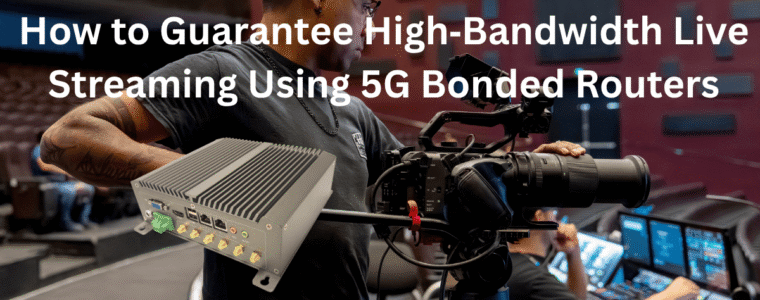
Live streaming has become a core requirement for modern events, productions and mobile operations. Whether you’re broadcasting from a festival field, a stadium, a corporate event, a pop‑up activation, or a remote location, audiences expect high‑definition, uninterrupted, low‑latency video — and they won’t tolerate buffering, pixelation or stream drops.
But traditional connectivity solutions regularly fail under real‑world conditions:
- Cellular networks become congested
- Single‑SIM routers drop when coverage changes
- Satellite links experience variable latency
- Temporary fibre isn’t always available on location
This is why professional streaming teams now rely on 5G bonded routers, such as the EMS i‑MO OptiBond 250, to deliver guaranteed high‑bandwidth connectivity anywhere — even under the heaviest load.
This article explains why single‑network streaming fails, how bonding solves it, and how the OptiBond 250 delivers broadcast‑grade performance in the field.
Why Traditional Internet Fails for Live Streaming
Event‑connectivity research shows that single‑connection solutions — whether cellular, fibre, or satellite alone — cannot guarantee stable streaming, especially at scale or in difficult locations.
The most common streaming failures include:
- Network congestion as thousands of attendees connect
- Dropped sessions when a single 5G or 4G cell degrades
- Unstable upload speeds, especially on shared 5G
- Coverage blackspots in rural or remote environments
- Weather‑related satellite fluctuations
- Single points of failure (one network, one outage = stream gone)
Live video is uplink‑intensive, meaning even small performance fluctuations can cause buffering or total stream failure.
Bonding prevents those failures.
What Is a 5G Bonded Router?
A 5G bonded router merges multiple 4G and 5G mobile networks — and optionally Satellite satellite and fibre — into a single, unified high‑bandwidth connection using intelligent packet‑level bonding.
EMS’s OptiBond™ engine inside the i‑MO 225:
- Aggregates bandwidth
- Balances network load
- Instantly reroutes traffic when any link fails
- Maintains session‑persistent connectivity
This means no buffering, no mid‑stream drops, no “please wait” screens.
The i‑MO 250 is specifically designed to bond:
✔ Multiple 4G/5G networks
✔ Satellite services (including Satellite)
✔ Fixed broadband / temporary fibre where available
This hybrid approach creates a connection stronger than any single bearer alone.
How Bonded 5G Guarantees High‑Bandwidth Streaming
1. Multiple Networks = Massive Upload Capacity
Bonding aggregates bandwidth across carriers to create a single, much larger uplink — ideal for HD and 4K streaming.
The OptiBond 225 is built to support high‑throughput streaming workloads in demanding, high‑user environments.
2. Seamless Failover With Zero Frame Drops
If one 5G network becomes congested or a cell tower weakens, OptiBond instantly routes traffic across the remaining links without dropping the live session.
This is crucial because standard failover drops the stream entirely when switching networks.
With OptiBond, viewers never notice a change.
3. Stability in High‑Demand Environments
Large‑scale events place huge demands on available networks. Bonded routers solve this by spreading load across:
- Multiple 5G carriers
- Multiple 4G carriers
- Satellite
- Fibre (if present)
This ensures reliable streaming even when tens of thousands of devices are connected nearby.
4. Low Latency for Real‑Time Production
Video encoders, cloud ingest platforms and multi‑camera workflows require stable, low‑latency connections.
The OptiBond 225’s intelligent routing is optimised for real‑time applications.
This makes it suitable for:
- Live broadcast trucks
- Drone uplinks
- OB units
- Remote production
- Sporting events
- Corporate keynotes
5. Rapid Deployment — No Fibre Needed
Outdoor and temporary locations rarely have fibre. Even where possible, fibre installs take weeks and cost thousands.
OptiBond routers offer plug‑and‑play setup, delivering stable connectivity in minutes — a key requirement for events and productions.
Real‑World Use Cases for 5G Bonded Live Streaming
✔ Music Festivals & Concerts
High‑density crowds need aggregated bandwidth; 5G alone isn’t enough.
✔ Sports & Outdoor Races
Mobile cameras and drones benefit from persistent multi‑network coverage.
✔ Corporate Events & Hybrid Conferences
Stable uplinks ensure flawless presentations and global streaming.
✔ Live News & Field Reporting
Keeps broadcast teams online in cities, rural zones or unpredictable conditions.
✔ Film & TV Production
Enables remote directors, live dailies and cloud ingest workflows.
✔ Emergency Services & Public Sector
Drone footage, body‑cam streams and tactical video need zero downtime.
Why Choose the EMS i‑MO OptiBond 225?
The i‑MO OptiBond 250 is specifically engineered for mission‑critical live streaming.
Key advantages:
- Bonds multiple 5G/4G networks + Satellite + fibre
- Provides uninterrupted streaming with session‑persistent failover
- Supports large numbers of connected users
- Offers low latency + high bandwidth for professional video
- Deploys fast for temporary or mobile productions
The New Standard for High‑Bandwidth Live Streaming
If your live stream must not fail, a single 5G router is not enough.
The EMS i‑MO OptiBond 225 delivers:
- Broadcast‑grade reliability
- High, stable upload speeds
- Multi‑network redundancy
- Failover with zero frame loss
- Fast deployment anywhere
- Support for demanding professional environments
Bonded 5G is now the industry standard for live streaming — and EMS leads the way with technology built for real‑world challenges.
Learn more or trial www.ems-uk.com/contact-us