
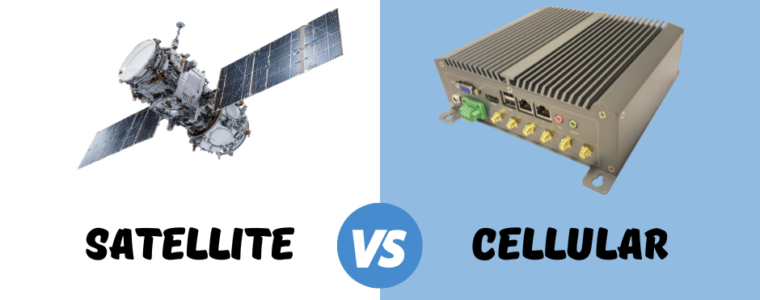
While standalone Starlink links and bonded cellular routers each provide meaningful improvements over legacy single‑transport architectures, they remain limited by the operational characteristics of their respective access networks. LEO satellite is constrained by line‑of‑sight and weather‑related attenuation; cellular is constrained by RAN coverage, radio noise, and backhaul congestion. As a result, neither solution consistently meets the deterministic performance requirements of high‑duty, mission‑critical environments when used independently.
A multi‑WAN bonded topology—specifically the EMS i‑MO 250—effectively eliminates these constraints by creating a unified virtual circuit across diverse physical transports. OptiBond™ achieves link aggregation at the packet layer, enabling bandwidth scaling across Starlink, 5G/4G, and fixed links while maintaining session continuity during link degradation or failure. This provides measurable gains in throughput stability, jitter control, failover response, and fault‑domain isolation.
For high‑density events, temporary industrial deployments, broadcast operations, and emergency response infrastructures, the engineering advantages are clear: only a heterogeneous bonded‑WAN system can maintain consistent network performance under variable RF, environmental, or backhaul conditions. As organisations demand predictable, carrier‑agnostic connectivity at the network edge, multi‑bearer bonding—exemplified by the i‑MO 250—emerges not as an enhancement, but as the required architecture for operational resilience, performance assurance, and service continuity at scale.
Starlink vs Bonded cellular vs Bonded WAN + Satellite
| Criterion | Starlink (remote internet) | Bonded cellular router (no satellite) | Bonded WAN + satellite with EMS i‑MO 250 |
| Typical throughput | 100–200 Mbps median; plans and hardware can reach higher (Performance kit up to 400+ Mbps) depending on plan and location. | Commonly 100–300 Mbps aggregate in strong 5G areas; single‑task speed equals the best single 5G link unless true bonding is used. | Designed for >500 Mbps bonded throughput for high‑density sites by aggregating Starlink + 5G/4G + fixed (multi‑WAN). |
| Latency | ~25–60 ms on land (median ~25.7 ms reported; target ~20 ms); higher in remote maritime/Polar regions. , | 1–20 ms typical on 5G; rises with coverage/cell load. Bonding service may add small overhead. | Session‑persistent bonding with application steering keeps latency low by routing tasks over the best link (e.g., real‑time over cellular, bulk over satellite). |
| Reliability / resilience | High in clear‑sky locations; can be affected by obstructions, weather, or local congestion; single link = single point of failure. | Better than single SIM thanks to multi‑carrier diversity, but still dependent on cellular coverage and tower congestion. | Highest: true multi‑bearer bonding + instantaneous failover across Starlink, cellular and fixed for near‑100% uptime at events/remote sites. |
| Mobility / deployment | Portable kits; set up in minutes; requires clear sky and power. Widely used for field ops and emergency response. | Very portable; works anywhere there’s 4G/5G; ideal for urban/suburban mobility, vehicles, small sites. | Rapid, plug‑and‑play deployment; built for large events, construction, disaster recovery; supports multiple Starlink terminals + Wi‑Fi 6 for public/crew Wi‑Fi. |
| Single‑task speed (e.g., a big upload/livestream) | Strong; single path only (no aggregation across different networks). | Load balancing ≠ bonding: single task stays on one link unless you use true bonding (then speeds aggregate). | True bonding aggregates multiple WANs into one virtual pipe, boosting single‑task throughput and maintaining the stream through link drops. |
| Concurrent users / high density | Good, but capacity depends on local beam load; one Starlink may not be enough for thousands of users. | Good in strong 5G, but cell congestion and spectrum sharing can limit performance at large events. | Built for crowds: up to 5 WAN ports for multiple Starlink modems + cellular/fixed; Wi‑Fi 6 for managed high‑density SSIDs. |
| Failover behavior | Not applicable (single link). If Starlink drops, service pauses. | Hot‑failover/load‑balanced across carriers reduces drop risk; still cellular‑only. | Seamless failover: traffic persists across satellite/cellular/fixed; OptiBond™ maintains sessions during link changes. |
| Power & environment | Performance kit: −40 °C to +60 °C, IP68/IP69K; 75–100 W typical draw; wind rated. | Typical 5G routers 15–30 W; environmental rating varies by device. | i‑MO 250: −20 °C to +50 °C; 12 V DC/PoE/AC; rugged aluminium chassis; multi‑WAN Ethernet (2.5 GbE). |
| Costs (indicative) | Hardware from £/$349–$2,500+ depending on kit; monthly depends on plan (Residential, Roam, Priority). | Hardware varies; SIM/data plans per carrier; lower hardware cost than satellite but data often capped. | Enterprise router hardware + Starlink + cellular + (optional) fixed; higher upfront, but offsets downtime risk at mission‑critical sites. |
| Best‑fit use cases | Off‑grid sites, maritime, aviation, remote events with limited/no cellular. | Vehicles, pop‑ups in urban/suburban areas, small teams, mobile logistics with good 5G. | Large events, construction, broadcast, public safety, disaster recovery needing guaranteed uptime and high user density. |
Conclusion
Choosing the right remote‑connectivity strategy comes down to one question: How much downtime can you afford?
Starlink delivers powerful standalone satellite broadband for remote or off‑grid locations, while bonded cellular routers offer mobility and multi‑carrier coverage in areas with strong 4G/5G availability. But when uptime, capacity, and uninterrupted performance are critical, a single network type is rarely enough.
That’s where the EMS i‑MO 250 stands apart — intelligently bonding Starlink, cellular, and fixed‑line networks into one resilient, high‑speed connection. From large‑scale events and construction sites to broadcasting, public safety, and emergency deployments, the i‑MO 250 ensures the performance, failover, and scalability organisations need to operate with confidence. As connectivity demands grow, multi‑bearer bonding isn’t just an upgrade — it’s becoming the new standard for teams that simply cannot go offline.
To find out more about optimising your connectivity contact EMS today.